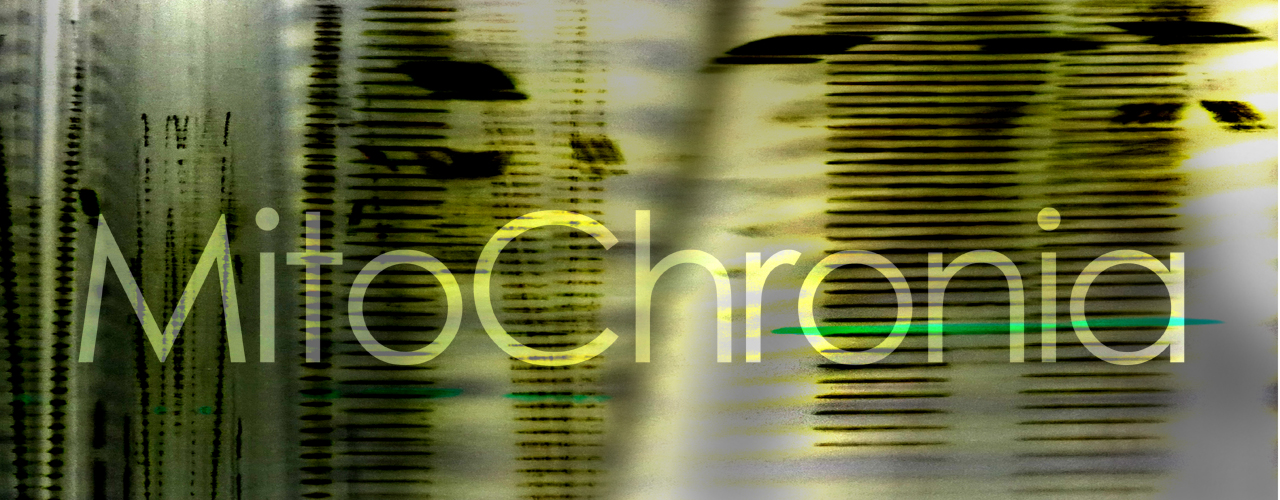
An art /science hybrid exhibition on the theme of mitochondria
Photos of the Exhibition |Contact | Visit | Gallery Plan | A4 Flyer
At the Art in Perpetuity Trust (APT) Gallery
6 Creekside, Deptford, London SE8 4SA
7th to 17th May 2026. Thursday to Sunday 12 to 5 pm.
Private View: 7th May. 6 - 8 pm
Finissage with explanatory artist tour: Sunday 17th May. 2-5pm
Life was nothing but green slime over a billion years ago during the Archaen period. This was known as the 'Boring Billions'. They didn't do very much but were good at staying alive. Then, over time, one of these decided they could live inside of other cells and were called mitochondria. They provided energy to the host and shared DNA. In return they were granted protection from the elements and various predators.
By providing this energy it allowed the host cell to engage in all sorts of activity and enable evolution into different types. Cells could then combine into organs with different functions and these could respond to changes in the environment. Mitochondria were divided into both male and female but in the end it was the maternal line that came to dominate and which we recognise today. Organisms are born with approximately 120 years of mitochondria after which they die, along with the animal itself.
The Mitochronia exhibition pursues this theme, exploring the properties of these organelles as they evolve though time, their Archaean ancestry and the role they have in contemporary therapeutic solutions. Mitochondria thrive on red and infra-red light. These are components inherent in sunlight and, as such, form an important element in metabolic health. It is only recently that this form of light has been recognised for its importance.
This exhibition is part of an occasional series exploring different aspects of science and natural philosophy within an art environment. These can be found on the Cipango website and cover several topics. Cipango was the ancient name of Japan, a place that Columbus was trying to reach when he accidentally discovered America. Essentially it was a place in the East reached by going West and contrarian in nature.
Curated by Paul Malone and Nicola Rae
Assistant curators: Haoyue Chen and Yuen Zhou
Please click on the names for the participant's Mitochronia page with further information
 Andrea Abbatangelo #01
 David Ian Bickley #02
 Mona Bourbia #03
 James Mark Brown #04
 Véronique Chance #05
 Bernice Donszelmann #06
 Shuhei Kono #07
 Paul Malone #08
 Katya Mora #09
 Nicola Rae #10
 Chi Kiu So #11
 Zhenzhen Tian #12
 Huan Wang #13